FlemingClans.com

"Scotland's Fleming Clan: a Genealogical History" - coming in 2027!
 14th chief - Malcolm Fleming, 3rd Lord Fleming
(1494 - 1547)
Basic information about this person: \click here\
Malcolm, 3rd Lord Fleming, was Great Chamberlain of Scotland for more than twenty years, son-in-law of King James IV and founder of the collegiate church at Biggar. Captured by the English at Solway Moss, he was killed fighting them at Pinkie in 1547.
Avenging his father
Malcolm was born on 14 January 1494, the son of John, 2nd Lord Fleming, and Euphame Drummond. He was already acting for the family in 1520, when he granted the burgesses of Kirkintilloch their burgage lands, and when his father was murdered by the Tweedies of Drumelzier on 1 November 1524 he succeeded him as Lord Fleming and as Chamberlain of Scotland.
He pursued his father’s killers through the courts for years. In 1525 he had the respite granted to the Tweedies annulled, in 1527 he received the gift of John Tweedie’s forfeited lands, and in 1529 and 1530 he had Tweedies and their accomplices bound over to stand trial and an inquest ordered them to pay compensation. The feud was finally settled by arbitration in March 1531.
The king’s son-in-law
In 1525 Malcolm obtained a papal dispensation to marry Janet Stewart, a natural daughter of King James IV and half-sister of King James V. The marriage made him brother-in-law of the king. Janet bore him a large family and later became governess to the young Mary, Queen of Scots.
Great Chamberlain
Malcolm held the office of Great Chamberlain of Scotland from 1524 until his death, and he witnessed scores of royal charters in that capacity. He sat regularly in Parliament and among the Lords of the Articles. He survived the upheavals of James V’s minority, including the fighting at Melrose and Linlithgow Bridge in 1526, and in 1528 he swore before the king to give no support to the fallen Earl of Angus. In 1536 the king left him in charge of Liddesdale and then took him on the voyage to France to find a royal bride.
He was an energetic landholder. In 1526 the king erected Biggar and Kirkintilloch into free burghs of barony, in 1531 Malcolm became Sheriff of Tweeddale and Peebles, and in 1538 his estates were re-granted and erected into five baronies. He also fought a long and ultimately unsuccessful battle with Lord Hay of Yester over the sheriffdom of Peebles.
Solway Moss and the Tower
In November 1542 Malcolm was captured at the rout of Solway Moss, where a Scottish army was routed by a much smaller English force. He was lodged in the Tower of London and on 26 December was entertained by King Henry VIII at Hampton Court, as Henry tried to win the captive lords over to his plans for Scotland. Malcolm was released on promise of a ransom of a thousand merks, secured by the hostage of his son, and returned to Scotland in January 1543.
King James V died within weeks of Solway Moss, leaving the infant Mary as queen. Malcolm at first went along with the plan to marry her to Henry VIII’s son, but by August 1543 he had turned against it. He served on the council that advised the Regent Arran, and he fought against the English at Coldingham in 1544.
Biggar Collegiate Church
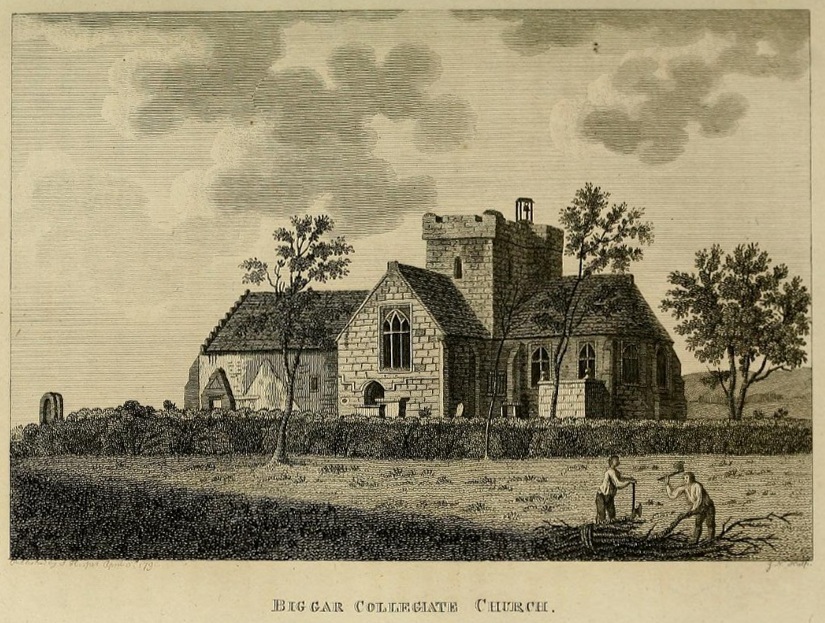
On 16 January 1545 Malcolm founded the Collegiate Church of Biggar, dedicated to the Holy Trinity and the Virgin Mary, and endowed it with the rights of the parish of Thankerton. It was one of the last such foundations before the Reformation, and the church still stands today.
Death at Pinkie
After Henry VIII’s death in January 1547 an English invasion was expected, and Malcolm made his will. On 10 September 1547 he was killed at the Battle of Pinkie near Musselburgh, one of the last great battles between the Scottish and English kingdoms.
Malcolm and Janet had seven children, including his heirs James and John; Margaret, later Countess of Atholl; and Mary, who became one of the “Four Marys” who served Mary, Queen of Scots. He also had several children born outside marriage. His nickname, “the Brave”, honours a life that ended on the battlefield.